A kilim dog collar from BohoBarks has three working parts: a full-grain leather body, a handwoven wool band in its face, and brass-tone hardware. Stitching ties them together. Each part has a job, and the whole thing is only as good as the joins.
What are the three parts of a kilim dog collar?
Here is the short map. Later sections take each row in turn.
| Part | Made of | Job |
|---|---|---|
| Body | Leather, stitched edges | Strength, shape, adjustment |
| Band | Woven wool | Color and pattern |
| Hardware | Brass-tone buckle, D-ring, rivets | Closing, plus leash and tag attachment |
Kilim refers to the style of weave. If you came for the history of that word, or for how flat-woven cloth gets made, our piece on what a kilim is covers it. Here we stay on the object itself.
What is the leather body for?
Heavy lifting. Every tug on a leash, every lunge at a squirrel, travels through the strap.
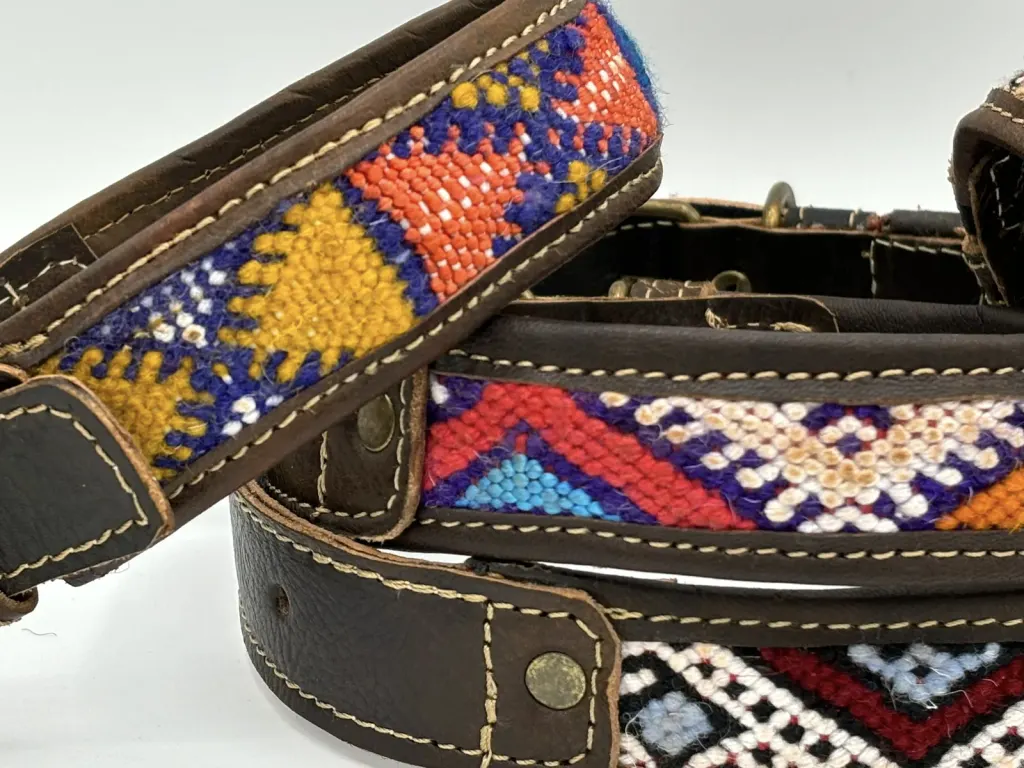
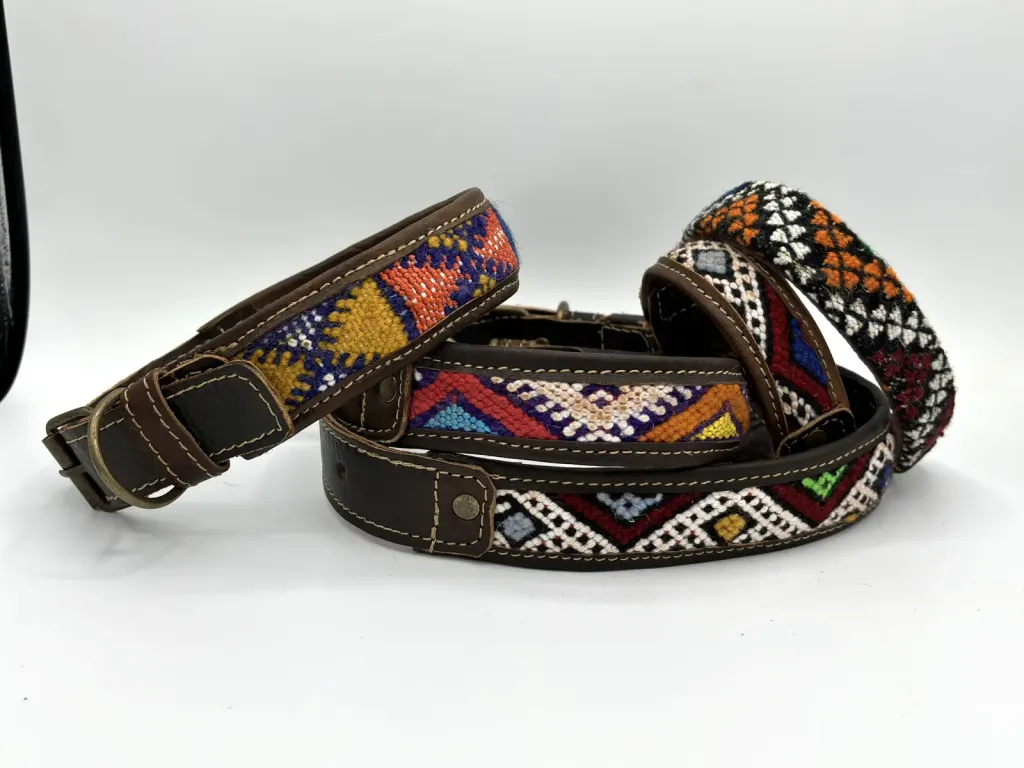
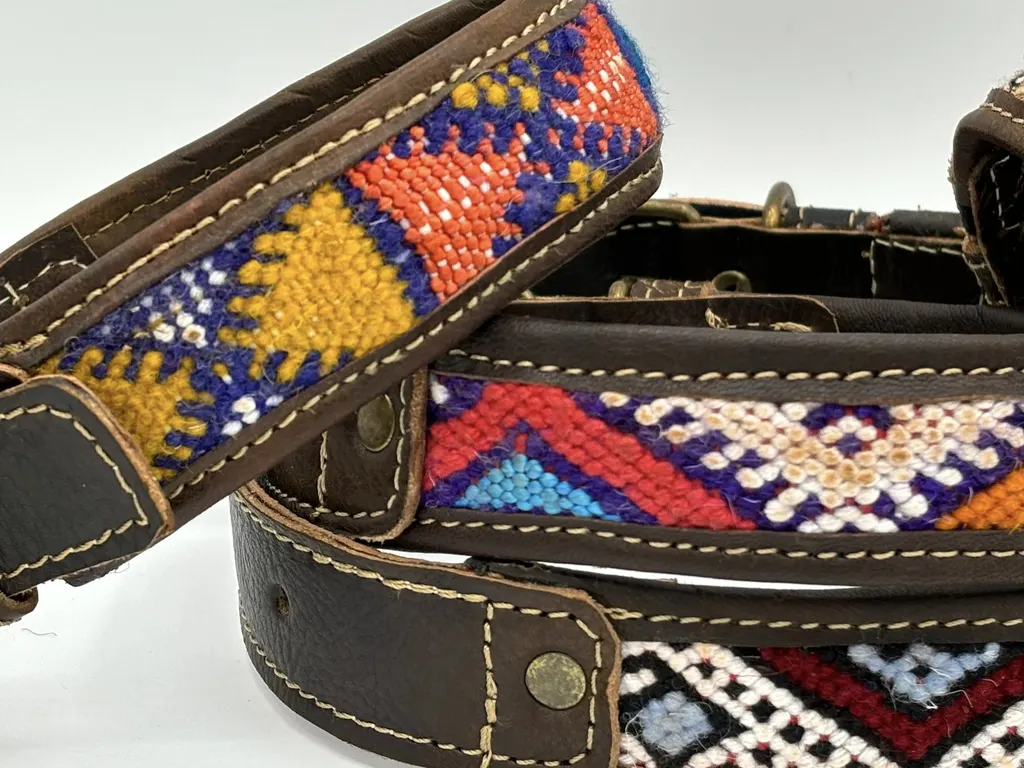
The photos let you read the construction, and it is more involved than a plain leather belt: two strips of dark leather run beside the bright band to form a shallow trough, cream thread follows each edge, and near the ends the strap folds into a stitched tab while small leather loops keep the loose tail flat.
Turn one over. The inside is plain leather with a row of punched holes where the buckle tongue goes. That row explains something about sizing: each of our four sizes spans a stretch of neck measurements rather than a single number. How those stretches overlap has its own write-up in the between-sizes guide.
As for the grade of hide, our handmade versus mass-produced piece explains the term. Leather softens as it ages. It also wants a bit of upkeep, covered in the leather care guide.
Why use the word kilim at all?
Shorthand, and a fair one. The band comes from the Berber carpet and kilim tradition of North African weaving, where bold geometric motifs are the norm, and the term travels well. We never claim a specific village, loom or technique for any single design, because nobody has told us one.
How does the woven band sit in the leather?
This is the part people ask about. A strip of wool rests in that trough, and a line of stitches on each flank holds it down.
Because it lies below the raised edges, leather stands guard on either side. A small point? On a dog who brushes past doorframes all day, hardly.
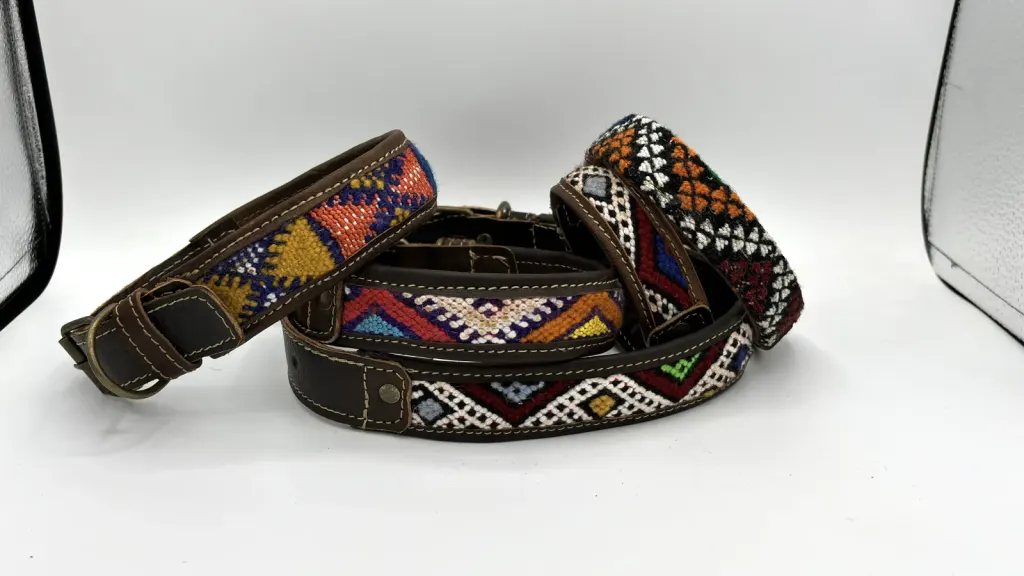
Look closely and the surface turns nubby and tufted instead of smooth. Single points of color stack into diamonds, triangles and zigzags. Two designs show the range: Berber Sands pairs cream and black with a slash of red, while Medina Mosaic crowds in orange, red and yellow blocks.
No ink is involved. The color is the yarn. For the people and looms behind this kind of textile, read about Moroccan weaving traditions. Our own claim stays short: handwoven in Morocco.
What metal goes on one?
Three small pieces, three different duties.
- Buckle. A brass-tone frame with a tongue. It closes the strap and lets you choose a hole.
- D-ring. Hung through a stitched leather loop, it takes the leash clip and ID tags.
- Rivets. Round studs that pin the strap tabs down beside the stitching.
The metal matches the brown hide. It looks warm and slightly aged, never chrome-bright. After any soaking, wipe it dry.
How do the pieces hold together?
Picture a short chain. Leather carries the load, thread binds leather to wool, and hardware gives you somewhere to clip on, so a weak link cannot borrow strength from its neighbors, however good the rest looks.
That is why we point owners to the weak spots: the seams, the stitches around each tab, and the spot where the ring’s loop meets the strap. A tag hangs from that ring, and whatever brings a lost pet home deserves a quick look now and then, before it gives you a reason.
Nothing here is exotic. Hide, wool, thread and metal are old materials, and anyone holding one of these can follow how it was made. That is part of the pleasure.
What should you notice when it arrives?
Pick it up and run a thumb along the edge. A few stray wool fibers poking out of the band are normal for handwoven yarn. Then go through a brief checklist:
- Cream stitching runs unbroken on both sides.
- The tongue slides in and out of its hole without a fight.
- The loop holding the D-ring feels firm when tugged.
- The studs sit flat against the tab.
If something looks wrong, tell us before the first walk. Exchanges apply to unworn collars, and the shipping and returns page explains the rest.
Why do no two collars look quite alike?
Hands made them. A weaver sets each yarn, so shapes never match from band to band down to the last tuft, and shades of one color can drift.
We make small batches, about 200 per design. The photo on each product page shows a sample, not a copy. To compare every pattern in one sitting, meet the BohoBarks designs for a quick tour.
How does construction affect sizing?
Most of it comes down to that punched row. Move the tongue and the loop tightens or eases, while the sewn tab holds the spare strap in place. Ranges run XS 8 to 11 inches, S 10.5 to 14, M 13.5 to 18 and L 16 to 23. Take a tape to the neck first, then match the number using the size guide and the walkthrough on measuring your dog.
Frequently asked questions
Is the bright band printed or actually woven?
Woven. Yarn tufts are visible in our photos, row after row. Printed cloth looks flat and even, with no loose fibers along its edges.
What does brass-tone mean?
It names a finish, a warm golden-brown like old brass. We say tone because we are describing color, not making a claim about what the metal is made of.
Why do two collars of one design look different?
People weave each band, and nobody can place every yarn identically. Shades shift, motifs land off-center, and we make only about 200 of any design. Expect a sibling, not a clone.
Which part deserves the most frequent look?
Stitching and the D-ring, because leash pull lands there. A glance at each walk is enough, and the signs of a worn-out collar are listed in our upkeep article.
Ready to pick a pattern? Shop all eight designs. Each costs $50 in every size.