For most large dogs, the best everyday collar is a flat buckle band in full-grain leather with sturdy metal hardware, sized so two fingers slide under it. Hard pullers do better on a harness or gear a trainer recommends. Our size L fits necks from 16 to 23 inches.
What should a strong dog’s collar be made of?
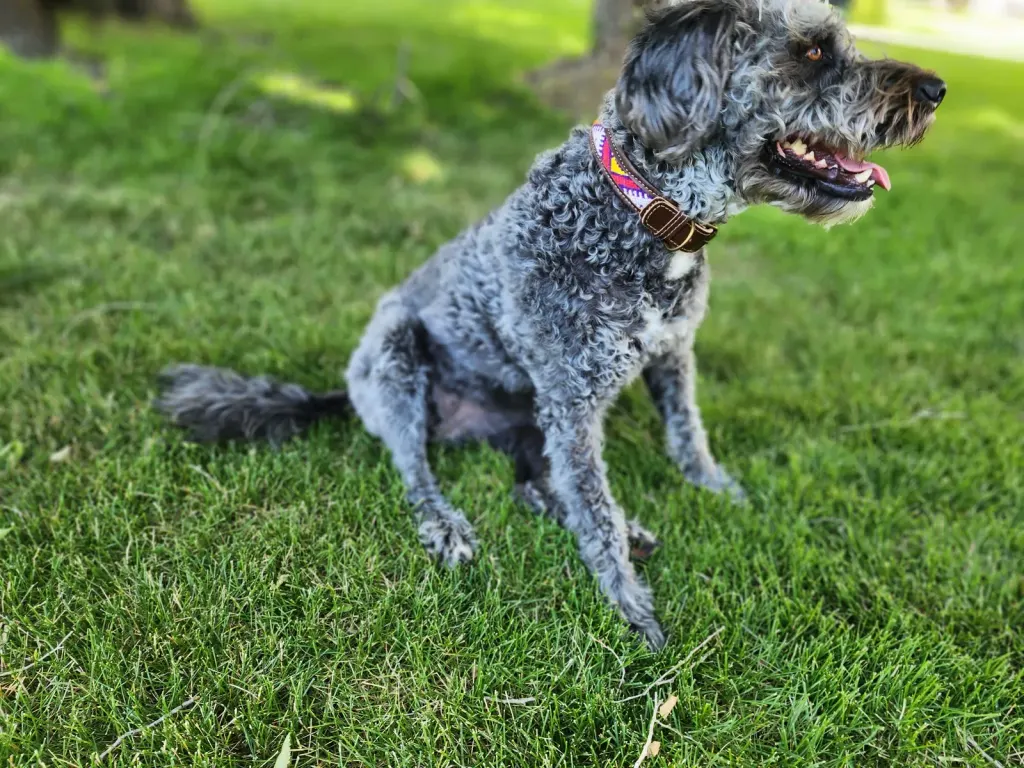
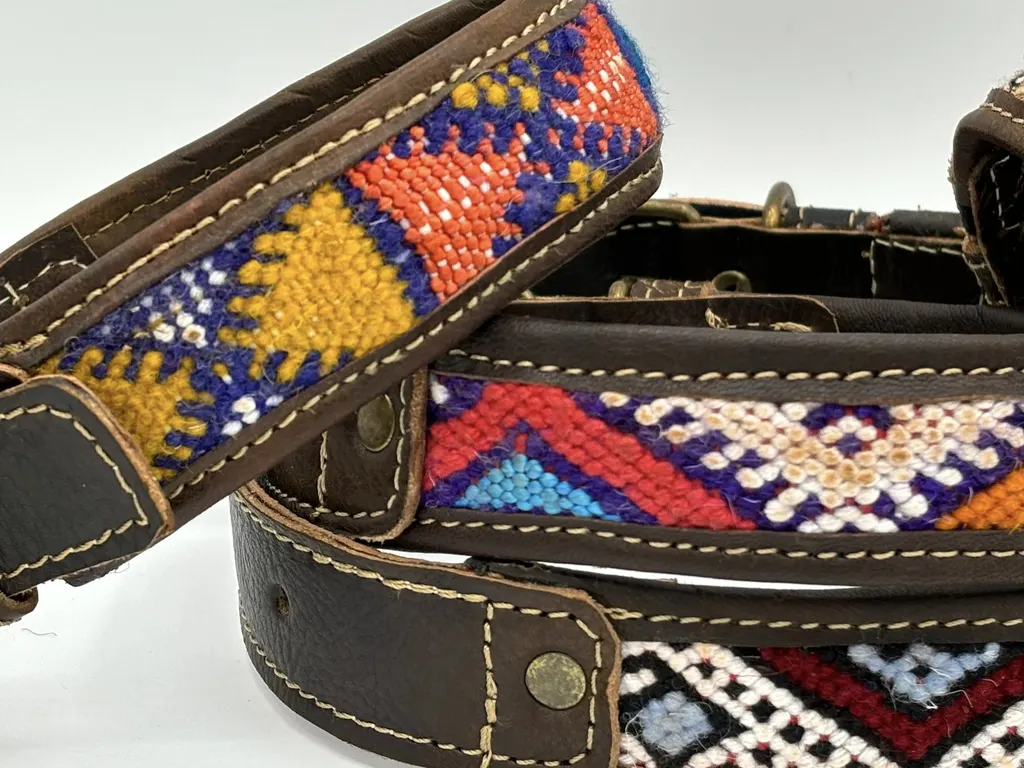
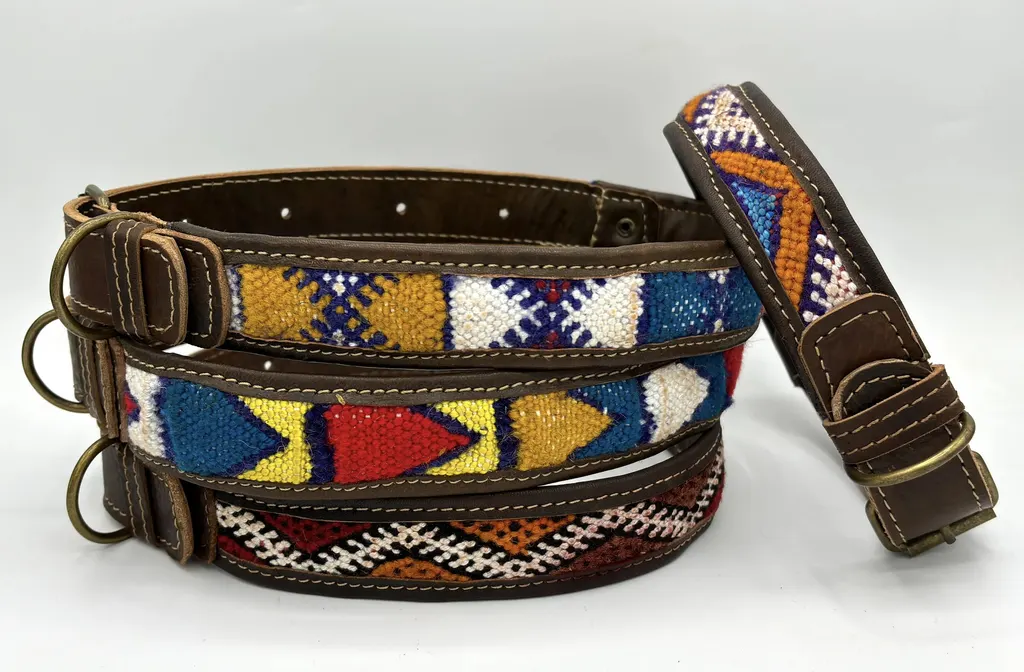
Leather and nylon both work. Nylon is light and washes easily. Leather takes more care, yet it softens against the neck and ages with a handsome patina. Ours sets a woven wool band on leather, plus brass-tone hardware and a D-ring for tags and the lead. Our materials page covers each layer.
Big dogs test gear harder than small ones do, so build quality matters more than looks. The next few sections cover size, fit and the situations where a different tool makes sense.
Which size fits a large dog?
Our L covers 16-23”. Measure first, because breeds this big vary widely. These figures come from Canine Journal’s breed table; other charts differ by an inch or two.
| Breed | Typical neck |
|---|---|
| Greyhound | 14-18” |
| Vizsla | 15-22” |
| Siberian Husky | 16-22” |
| Boxer | 16-22” |
| Weimaraner | 16-22” |
| Golden Retriever | 16-24” |
| Labrador Retriever | 18-24” |
| German Shepherd | 18-24” |
| Doberman Pinscher | 18-24” |
| Bernese Mountain Dog | 20-26” |
| Great Dane | 20-26” |
| Rottweiler | 24-30” |
A 16-18” neck could wear M or L, and our care card gives the tiebreaker: size down for a snug, secure fit. The how-to-measure guide shows the steps, and the size guide lays out all four ranges.
Mind the ceiling, though. L stops at 23”. Rottweilers, mastiffs and Newfoundlands often measure beyond it, and PetSmart’s chart puts the biggest breeds at 24 to 30 inches.
How snug should the band sit on a big dog?
The American Kennel Club says two fingers of room suits large breeds, where small dogs get just one. Too much slack invites an escape, the club warns. Thick double coats complicate matters, so press through the fur to find the neck, then confirm the same finger gap once the band is buckled.
Do large-breed puppies outgrow collars quickly?
Faster than you would guess. A UK pet-collar site’s puppy-to-grown chart shows a Labrador at 8-12 inches around the neck at two months and 14-20 inches when fully grown. A second chart lists a higher Lab range, 18-24 inches. Two charts, two answers, and that gap is the whole argument for trusting your own tape.
RSPCA Australia says medium and large breed puppies should start in a small collar and move up as they grow, with fit checked at least a few times each week. A handwoven leather piece is a better buy once growth has slowed.
Does a hard puller need different gear?
Often, yes. A big dog that leans into the lead puts all that force on a narrow strip of neck. AKC points to a front-clip harness for steering and a head halter as the highest-control option for large dogs that pull. RSPCA Australia prefers a front-attach harness too, paired with reward-based loose-leash training and a trainer’s help in fitting it.
RSPCA Australia describes a handy setup for dogs that still pull: a double-ended lead, with one clip on the harness’s front ring and the other on its back ring or on the neck collar. You walk the dog from the back clip and use the front one for turning whenever tugging starts. That keeps the collar doing its everyday job of holding tags.
The same RSPCA page draws a hard line: choke chains, slip collars and prong collars must not be used, because they cause pain and can damage the neck. It also advises against retractable leads, and warns that thin leashes with small clips tend to snap on large dogs.
So here is where we land. A BohoBarks collar carries tags, looks striking and handles easy walks. For a dog that surges ahead, add a harness, and our full comparison of both options weighs the trade-offs.
What about slim heads and flat faces?
Greyhounds and whippets often have heads smaller than their necks. The AKC says these dogs can back out of a loose flat collar, and recommends a martingale, a limited-slip style, when neck and head are close in size. RSPCA Australia suggests a harness for greyhound types. Ours closes with a plain buckle, not a limited-slip loop.
Short-nosed big breeds need extra thought. Cornell’s veterinary college lists boxers and bullmastiffs among breeds affected by airway obstruction, and for mild cases it advises using a harness instead of a neck collar. If your boxer wheezes or struggles to breathe in warm weather, ask your vet.
Which checks come first on arrival day?
Run a five-minute inspection before the first walk. Tug the D-ring and watch whether the stitching around it shifts. Press the buckle tongue through a hole and check that it sits snugly. Flex the strap near the holes, where leather flexes most. Then buckle it on your dog, slide two fingers under, and walk once around the yard. Anything that rattles, rubs or twists gets fixed now, not on a trail.
Once it passes, a little routine care goes far. Wipe with a damp cloth and mild soap, dry the band away from heat and sun, brush the weave, and condition the leather every few months. The care page lists the full routine.
Which designs look best on a sturdy frame?
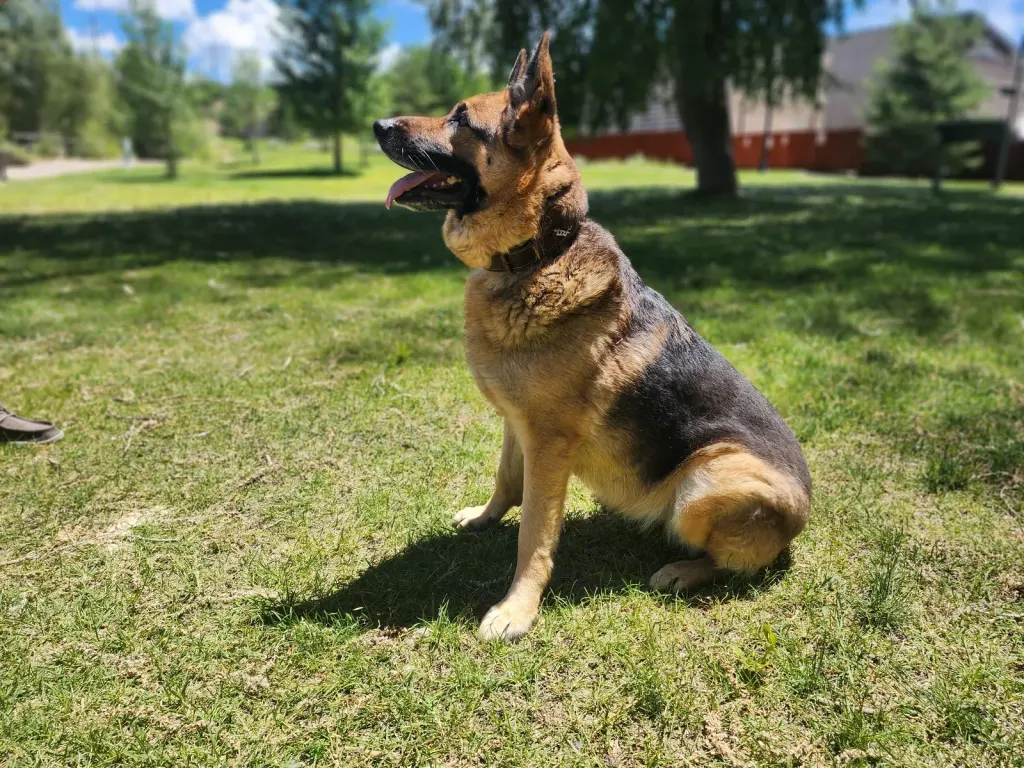
Wide necks give a pattern room to breathe. Atlas Adventure combines indigo, saffron-orange and cream, with a splash of yellow. Arabian Nights is a bolder mix of yellow, red and bright blue. Berber Sands pairs cream with black and a rusty red, dotted with orange. Brown leather also suits a tan-and-black coat like the shepherd’s in the photo above. Dark coats make yellow and blue leap out, while cream or golden ones flatter deep indigo. Because each band is handwoven, expect small differences from the pictures.
Frequently asked questions
Which collar size suits Labs?
Most Labs land in our L, though charts disagree about where a Lab’s neck tops out. Ranges run from about 14-20 inches to 18-24 inches. A Lab at the high end sits just past our 23-inch limit, so measure before ordering.
Is leather strong enough for a big dog?
For daily wear, yes, provided the build is sound: tight stitching, a firmly seated ring and a dependable buckle. We do not publish breaking-strength numbers, so judge the hardware with your hands. A dog that hauls on the lead belongs on a harness whatever the material.
How often should a leather collar be replaced?
Retire it when cracks show around the punched holes, the ring loosens or thread frays. With regular care, a collar can last for years. Take it off for swims and baths, since soaking warps leather.
Can a Great Dane wear size L?
Probably not. Charts put Great Dane necks at 20-26 inches or higher, against a 23-inch limit on L. A Dane who measures below that could fit, but most will need a bigger collar from another maker.
Ready for size L?
See every design in size L (16-23”) in the shop. Each one costs $50 and ships from Durango, Colorado, handwoven in Morocco.