For most small dogs, the best collar is a light flat-buckle band with a finger or two of slack, worn daily for tags and style. Add a harness for walks if your pup pulls or has a delicate windpipe, because a collar is no pulling tool. Our XS (8-11”) and S (10.5-14”) fit toy and small breeds.
What makes a collar good for a tiny neck?
Fit comes first, then weight, then hardware.
Fit: the American Kennel Club says one finger of room suits petite dogs. A loose band spins, and a spinning band sits one tug from slipping over the ears.
Weight: match the collar with a featherlight lead. RSPCA Australia warns that thick leashes with large clips often overload small frames and can strain neck and spine.
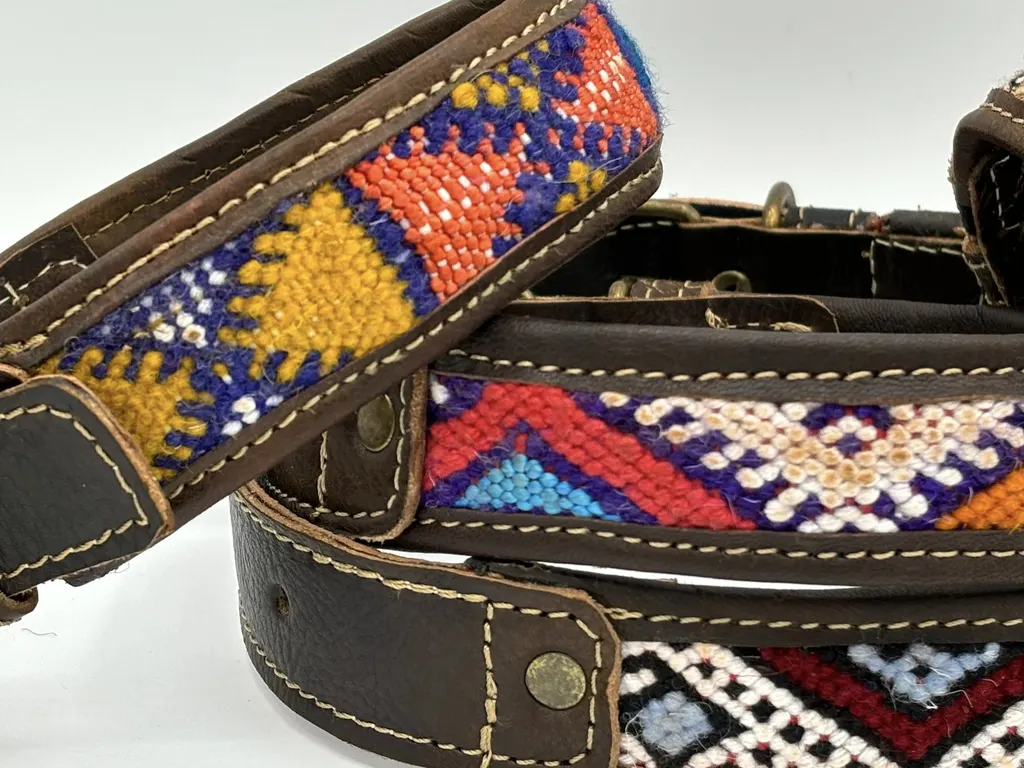
Hardware: seek a solid buckle plus a ring that holds an ID tag. Ours carry brass-tone fittings with a D-ring, set on full-grain leather that wraps a handwoven wool band.
Extra ounces matter on a very tiny dog, so scale the band to the frame.
Does a small dog need a collar, a harness, or both?
Usually both. The collar carries tags and looks good. A harness spreads walking pressure across the body rather than the throat, and the AKC calls a back-clip harness a popular choice for small dogs because it can prevent throat damage during pulling.
The stakes rise for certain breeds. Tracheal collapse, a weakening of the rings that hold the windpipe open, is most common in toy and miniature breeds, according to the Merck Veterinary Manual. Its signature is a dry, honking cough. The AKC adds that neck pressure can worsen the cough, and lists a harness in place of a collar among management steps.
Flat-faced little dogs face a related risk. Cornell’s veterinary college names pugs, Boston terriers, Pekingese and shih tzus among breeds prone to airway obstruction, and for mild cases it advises using a harness instead of a neck collar.
None of this replaces professional care. Persistent honking, noisy breathing or a fainting spell deserves an appointment. Our own view is simple: a BohoBarks collar suits ID duty and calm strolls. Pullers need other gear, and our comparison of collars and harnesses explains why.
Where should a harness sit and fit?
Snug, with room to breathe. PetMD advises slipping two fingers beneath it, yet not so loose that your dog can escape. Dogs have two exits, wiggling out the front or backing out the rear, so test both. Adjust one buckle at a time until the strap sits where it should, and watch the armpit area for rubbing. For small dogs the AKC allows a single finger of gap here, same as with collars.
Which size fits a small dog?
Begin with typical figures, then measure your own pup. These come from Canine Journal’s breed table, and charts disagree by an inch or two.
| Breed | Typical full-grown neck |
|---|---|
| Yorkshire Terrier | 6-12” |
| Papillon | 8-12” |
| Miniature Dachshund | 8-12” |
| Chihuahua | 8-14” |
| Toy Poodle | 8-14” |
| Pomeranian | 10-14” |
| Maltese | 10-14” |
| Shih Tzu | 10-14” |
| Cavalier King Charles Spaniel | 10-16” |
| Pug | 12-16” |
Read the table like this. Anything topping out near 11” points to XS. A 10-14” range suggests S. Wider spans straddle two sizes, so let a tape settle it. Our how-to-measure guide walks through the steps, and the size guide shows every range at once.
Between sizes, size down. That is the rule printed on the care card. And a heads-up: teacup Yorkies and the tiniest Chihuahuas can measure under 8”, which falls below where XS begins.
Can a narrow head slip a flat collar?
Yes. Whippets and greyhounds often have heads smaller than their necks, and Italian greyhounds are the pocket-size version of that shape. The AKC says loose collars let dogs like these back out and escape, and suggests a martingale, a limited-slip style, for dogs whose necks match their heads. RSPCA Australia goes further for greyhound types and prefers a harness. Ours closes with a plain buckle rather than a sliding loop, so it works best on dogs with a clear neck-to-head step.
What is the gentlest way to introduce a first collar?
Slowly. For puppies learning to walk on a leash, the AKC says to stick with a standard buckle collar, and many trainers begin lessons with a 4-foot leash. Let the pup sniff the band, fasten it for a few minutes while treats flow, then remove it before any fuss starts. Short, pleasant sessions teach more than one long struggle.
Pulling is normal early on. RSPCA Australia recommends loose-leash walking: stop like a tree when the line tightens, then reward every step taken with slack.
Leather, nylon or fabric: which suits a small dog?
Each material earns its place.
| Material | What it does well | What it costs you |
|---|---|---|
| Nylon webbing | Light, cheap, quick to dry | A plain look, little character |
| Leather | Softens with wear, ages well | More weight, occasional conditioning |
| Wool weave on leather (ours) | Color and texture that last | Keep it dry; no swimming or soaking |
Care is gentle: a damp cloth, mild soap and air drying, as our care page explains. Curious about the build? The materials page covers the leather and wool.
Which mistakes put small dogs at risk?
- Slack fit. A loose collar can let a dog wiggle out, as noted above.
- Retractable leashes. RSPCA Australia does not recommend them: a dog reaching the lead’s end takes a jerk that could damage the neck.
- Skipped re-checks. Puppies change fast, so inspect the fit a few times each week.
Which designs look good on small dogs?
Three catch the eye on a petite frame. Medina Mosaic pairs orange and red with pale blue-grey. Caravan Dreams pulls together mustard, rust-red and navy. Marrakesh Express is cream and black in a diamond pattern, with red running through it. Each band is handwoven, so small variations are normal.
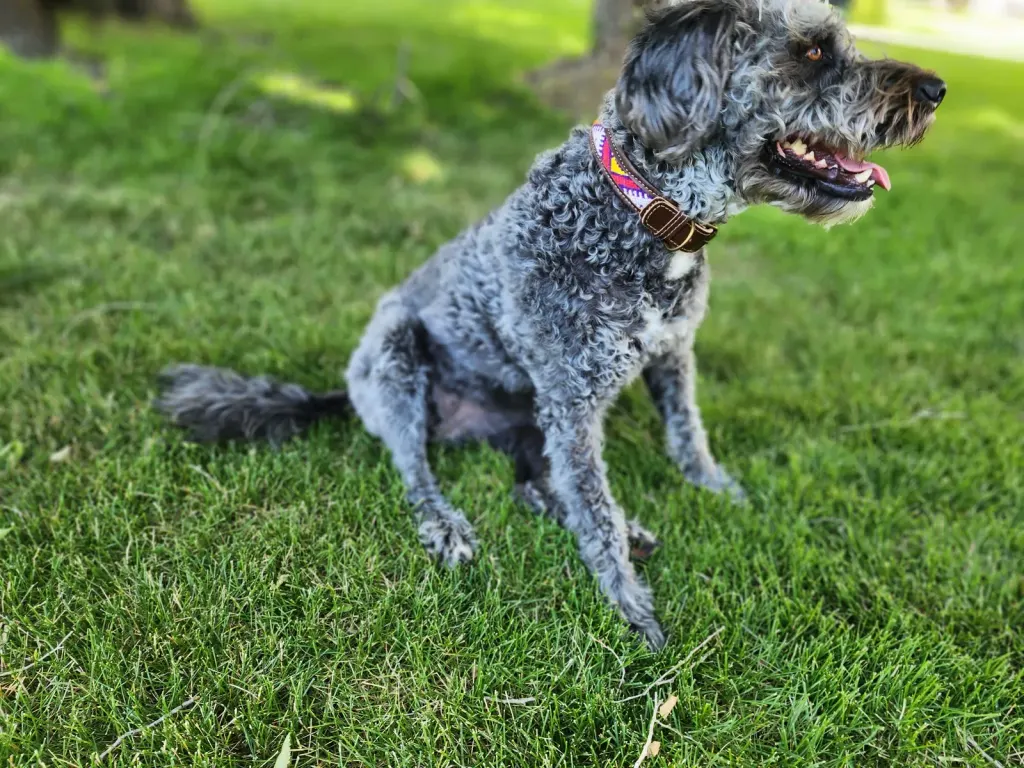
In the photo at the top, a grey curly-coated dog mid-pant wears pink, yellow and white zigzags that pop against its muted curls.
Frequently asked questions
Is a collar right for a Chihuahua?
Yes. Tags belong on the neck, and a woven band adds personality. Charts give full-grown Chihuahua necks of 8-14 inches, so XS or S is the likely fit. If a cough ever sounds like a goose honk, call your vet before the next walk.
What size collar does a Yorkie need?
Charts put full-grown Yorkshire Terrier necks at roughly 6-12 inches, with teacups smaller still. Many Yorkies land in our XS (8-11”), but teacups may sit below it. Measure first.
Is leather too heavy for a small dog?
It depends on the dog. A teacup-sized neck may prefer something lighter, while most small breeds in our XS and S wear leather without fuss. Exchanges are covered on our shipping and returns page, in case the feel is off.
Is a collar alone enough for walks?
Calm walkers often can. Dogs that pull, honk when coughing or have flat faces are safer on a harness, and your clinic should examine any breathing trouble.
Ready to shop the tiny sizes?
Browse sizes XS and S in the shop. Every design costs $50, ships from Durango, Colorado, and comes handwoven in Morocco.